It's not because going to church is important, or because it's the unbroken practice of Christians for two thousand years, or even because the third commandment is to keep the Lord's Day holy. Although these things are certainly at the heart of weekly attendance at church, none of them establishes an absolute requirement that we assist at Mass every single Sunday without exception. The real reason missing Sunday Mass is a mortal sin is, simply, because the Church says so.
A little precision is in order. First of all, there are obviously exceptions. As the Catechism notes, illness, the care of an infant, or even a dispensation granted by one's pastor can excuse a person from the obligation of attending Mass on a particular Sunday. Also, it's important to note that the Catechism describes willfully missing Mass on a Sunday or Holyday of Obligation as a "grave sin," not a "mortal sin." A grave sin only constitutes a radical turning of one's heart away from God when it is committed with "full knowledge" and "deliberate consent," and clearly there are times when the failure to attend Mass does not meet one or both of these criteria. Perhaps, for example, a person forgot yesterday to reset the clock for daylight saving time!
But if a person really does willfully miss Mass, fully knowing and deliberately consenting to what he is doing, he commits a mortal sin. And again, this is because the Church has so decreed. Specifically, it's the first of the precepts of the Church, which are "positive" laws, meaning that they have been established by the human authority of the Church, not by God Himself. The other precepts include yearly confession and reception of Holy Communion, observation of days of fasting and abstinence, and provision for the material needs of the Church. As the Catechism puts it, these precepts have been established "to guarantee to the faithful the indispensable minimum" they must put into "growth in love of God and neighbor."
Why am I making such a big deal out of our Sunday obligation being a man-made law? Because I think it's at the root of the rebellion of many people against it. We moderns find it hard to countenance that the power of "binding and loosing" has been granted to mere human beings. Who does the Church think she is to tell me that I have to keep the Lord's Day holy in the particular way they want, especially when they--that is, the cardinals, bishops, and priests--are caught up in sex abuse scandals? It's the same rebellion that afflicts so many Catholics with regard to the Church's sexual teachings, or her requirement that we confess our sins to a priest. Who are you to hear my sins? Who are you to tell me what is licit in my sex life?
Perhaps the greatest mystery of the Church's foundation is that Christ granted His own authority to weak human beings, including the grant of apostolic primacy to the very man who would fail in courage and deny Him three times. It's entirely, indisputably biblical, by the way. Christ told Peter that he is the "rock" upon whom He would establish His Church, and that "whatsoever you bind on earth shall be bound in heaven..." (Matthew 16:18-19).
But why? Why ascend into heaven and leave the likes of the Borgias and McCarricks in charge of things? Why establish a stumbling block, something that folks can point to when they'd rather do things their own way and say, as Ghandi supposedly did, "If it weren't for the Christians, I'd be a Christian." Whatever the answer, it has something to do with the capital sin of pride and Christ's example of humility, and something to do with removing the beam in my own eye before casting the mote out from the eye of my neighbor.
These days it takes a great deal of humility to be Catholic. Pray God that we all grow in that virtue. Attendance at Mass on Sundays, at a minimum, is a great place to start!
Monday, March 11, 2019

Friday, March 8, 2019
Worshipping in the wreckage
I felt yet another pang of sadness earlier today as I watched a video clip from the demolition of a decommissioned Catholic school not too far away from here, in Marshfield, Wis. It's the same pang I felt a few months ago after learning that the near-empty convent down the street from where I grew up not too far away in Stevens Point, a structure for which a team of horses owned by my own great-grandfather helped to haul the bricks, was to be sold off to developers, with the few remaining elderly sisters moving to a facility in Illinois. The magnificent, towering parish church from which that order of teaching sisters was born, my home parish, still holds three weekend services. But on the Sundays when I visit, the music echos strangely in the near-empty pews. I read that a north side alderman moved recently to silence the Angelus bells.
 On the far side of the Diocese of La Crosse where my wife grew up, and where we've inherited her parents' farm, we attend Mass at a magnificent ridge-top church built by German immigrant-farmers more than a century-and-a-quarter ago. These near-penniless newcomers mortgaged their farms and provided virtually all the labor in order to raise a church with a soaring steeple, which is today visible for miles around in the rugged, wind-swept countryside. Everything from the hand-hewn, hand-laid masonry on the outside to the beautiful, hand-wrought woodwork on inside bespeaks their pride, their sacrifice, and their devotion. Recently I came across an article I had written back in my journalist days about the closure of this exact-same parish's school a decade ago, one of the oldest schools in the state, a decision that made perfect sense given there were fewer than a dozen students in grades K-through-eight.
What is this pang, which I feel nearly every Sunday as I listen to my devoted pastor, who juggles the administration of this parish with two others, deliver his homily to dozens in a church built for hundreds? I know, I know, part of it is that demographics have changed; there simply aren't the families to draw on. There are too many churches in this diocese, where the push a century ago, in the era of horses and buggies, was to construct a church within seven miles of any geographic point, no matter how rural.
But let's not fool ourselves by blaming it on demographics. These structures were full just two generations ago, my grandparents' generation. While nearly everybody in my parents' generation was baptized and received the sacraments, something went awry, and only a percentage in my own generation received the sacraments. And if I had to tally up how many from my own Catholic high school class are today practicing their faith, I'd have to guess that I'd be able to count the number on my fingers.
We are one generation away from a radically smaller church, and it's apathy, plain and simple. Even out here in the rural countryside, my wife can point to farm after farm and say, that's the so-and-so family, and they used to be in church on Sundays. Many people have moved away, but many people are still here. And they're just not interested. The exuse is it's this or that priest, it's this or that scandal, it's this or that out-moded teaching. I understand, and yet I don't. Where is the faith that led families to mortgage their farms, their very livelihoods? Can it really evaporate just like that?
My personal take is that a lot of it had to do with lack of community. I don't know whether the same sort of intentional community that inspired these churches and schools is possible anymore. Our lives no longer revolve around our parishes. We have too many other geographically disparate identities-- work, schools, social groups, children's activities. Even the thriving North Carolina suburban parish we attended during our time there struggles to keep its school afloat, despite having thousands of parishioners. We have so many different identities, and even the most thriving of parishes only feed part of who we are. To be clear, I'm not blaming parishes, or priests, or, really, anybody at all. I have friends who are priests or who work in parishes who are doing heroic work. But it's just the modern reality that our allegiances are ephemeral.
Obviously these matters are too big for a blog post. There's more, theologically speaking, to church than weekly attendance at services. Really, there needs to be more, and that's why the church is dying. We aren't made to be bifurcated between our spiritual and social bonds, as our modern reality forces us to be.
So again, I don't have any answers today, only a peculiar strain of sadness that I wanted to express as the soaring structures of the past, shadows of their former selves, continue to crumble into dust.
Who knows, maybe we'll be born a smaller, purer church. In the meantime, I'll worship in the wreckage.
On the far side of the Diocese of La Crosse where my wife grew up, and where we've inherited her parents' farm, we attend Mass at a magnificent ridge-top church built by German immigrant-farmers more than a century-and-a-quarter ago. These near-penniless newcomers mortgaged their farms and provided virtually all the labor in order to raise a church with a soaring steeple, which is today visible for miles around in the rugged, wind-swept countryside. Everything from the hand-hewn, hand-laid masonry on the outside to the beautiful, hand-wrought woodwork on inside bespeaks their pride, their sacrifice, and their devotion. Recently I came across an article I had written back in my journalist days about the closure of this exact-same parish's school a decade ago, one of the oldest schools in the state, a decision that made perfect sense given there were fewer than a dozen students in grades K-through-eight.What is this pang, which I feel nearly every Sunday as I listen to my devoted pastor, who juggles the administration of this parish with two others, deliver his homily to dozens in a church built for hundreds? I know, I know, part of it is that demographics have changed; there simply aren't the families to draw on. There are too many churches in this diocese, where the push a century ago, in the era of horses and buggies, was to construct a church within seven miles of any geographic point, no matter how rural.
But let's not fool ourselves by blaming it on demographics. These structures were full just two generations ago, my grandparents' generation. While nearly everybody in my parents' generation was baptized and received the sacraments, something went awry, and only a percentage in my own generation received the sacraments. And if I had to tally up how many from my own Catholic high school class are today practicing their faith, I'd have to guess that I'd be able to count the number on my fingers.
We are one generation away from a radically smaller church, and it's apathy, plain and simple. Even out here in the rural countryside, my wife can point to farm after farm and say, that's the so-and-so family, and they used to be in church on Sundays. Many people have moved away, but many people are still here. And they're just not interested. The exuse is it's this or that priest, it's this or that scandal, it's this or that out-moded teaching. I understand, and yet I don't. Where is the faith that led families to mortgage their farms, their very livelihoods? Can it really evaporate just like that?
My personal take is that a lot of it had to do with lack of community. I don't know whether the same sort of intentional community that inspired these churches and schools is possible anymore. Our lives no longer revolve around our parishes. We have too many other geographically disparate identities-- work, schools, social groups, children's activities. Even the thriving North Carolina suburban parish we attended during our time there struggles to keep its school afloat, despite having thousands of parishioners. We have so many different identities, and even the most thriving of parishes only feed part of who we are. To be clear, I'm not blaming parishes, or priests, or, really, anybody at all. I have friends who are priests or who work in parishes who are doing heroic work. But it's just the modern reality that our allegiances are ephemeral.
Obviously these matters are too big for a blog post. There's more, theologically speaking, to church than weekly attendance at services. Really, there needs to be more, and that's why the church is dying. We aren't made to be bifurcated between our spiritual and social bonds, as our modern reality forces us to be.
So again, I don't have any answers today, only a peculiar strain of sadness that I wanted to express as the soaring structures of the past, shadows of their former selves, continue to crumble into dust.
Who knows, maybe we'll be born a smaller, purer church. In the meantime, I'll worship in the wreckage.
Tuesday, March 5, 2019
On this Carnevale, the extravagance of meat
This morning we fried up bacon for breakfast. Not thin-sliced "bacon-product" from the grocery store, mind you, but extra-thick, home-grown, home-smoked bacon. And why not? It's Mardi Gras today, French for "Fat Tuesday," and in the more challenging times of yore the final chance to eat food fried in animal fat before the beginning of the Lenten fast from all meat whatsoever, including meat by-products like lard, stock, and broth. That's where the Polish tradition of the deep-fried pączki comes from. Carne-vale, in Latin, is literally, "Farewell, meat."
Lenten practices have softened, because these days we Roman-Rite Catholics are permitted to eat meat all through Lent with the exception of Ash Wednesday and Lenten Fridays. And even on those days of abstinence, food prepared in rendered animal fat, like pączki, has been permitted for more than a century. It's indisputable that we've gone soft. But my reflection this morning, as I savored every bite of that home-grown bacon, is that, as a culture, we've lost any real sense of the natural extravagance of meat.

The extravagance of meat was one of the first big lessons of homesteading. Put simply, meat costs a lot to raise. I remember that the first time we raised pigs back in North Carolina we had another family that wanted to go "in" on half a hog. They offered to help with processing and split the feed costs down the middle. Now, 50-lb. bags of hog feed are expensive, and while I did my best to supplement with garbage bags full of expired bread from a discount bakery, the cost per pound ended up being significantly more than the average price per pound that you'd pay for conventional pork in the grocery store. I think it caught the other family by surprise. In any case, it was the last time they suggested going "in" on raising hogs.
These days we've gotten a lot better on the cost front. Since we're now farming on a larger scale, our Wisconsin pigs are fattened mainly on bales of our own hay, apples from our own orchard, and unsaleable squash from our own fields. But money is only part of the story. The pigs still need to be watered twice a day, and processing is a multi-day affair. Consider what went into that bacon even after the trouble of raising and processing the pigs. The bellies needed to be soaked in brine for a week or more, and then they hung for two full days in my home-made smoking box while I watchfully tend to a small fire in the attached pot-bellied stove day-and-night.
Of course, going to the store and buying plastic-wrapped Hormel bacon would have been vastly easier. And considering the value of my time, it may very well be cheaper option as well. But that's exactly my point. As a culture, we simply don't understand how extravagant meat is. Or thought of another way, contra naturam, perhaps meat is not extravagant anymore because it's so prevalent and so, so cheap. Why not eat meat with every meal when a pound of chicken breasts can be had for a dollar, and a pound of ground beef for two dollars?
I'll save for another day my reflections on the inhumane, environmentally deleterious practices that are needed to lower the price point of meat so dramatically. There are strongly held philosophical reasons behind my wife's and my choice to raise all of our own meat. For today, I'll state that meat, naturally speaking, is extravagant. Animals eat plant-based products and exert vast amounts of energy converting them into edible protein, which we then harvest. Even with intensive factory-farming practices, it still takes several pounds of feed to produce a pound of chicken, and nearly a dozen pounds of grain to produce a pound of beef,
Lenten practices have softened, because these days we Roman-Rite Catholics are permitted to eat meat all through Lent with the exception of Ash Wednesday and Lenten Fridays. And even on those days of abstinence, food prepared in rendered animal fat, like pączki, has been permitted for more than a century. It's indisputable that we've gone soft. But my reflection this morning, as I savored every bite of that home-grown bacon, is that, as a culture, we've lost any real sense of the natural extravagance of meat.

The extravagance of meat was one of the first big lessons of homesteading. Put simply, meat costs a lot to raise. I remember that the first time we raised pigs back in North Carolina we had another family that wanted to go "in" on half a hog. They offered to help with processing and split the feed costs down the middle. Now, 50-lb. bags of hog feed are expensive, and while I did my best to supplement with garbage bags full of expired bread from a discount bakery, the cost per pound ended up being significantly more than the average price per pound that you'd pay for conventional pork in the grocery store. I think it caught the other family by surprise. In any case, it was the last time they suggested going "in" on raising hogs.
These days we've gotten a lot better on the cost front. Since we're now farming on a larger scale, our Wisconsin pigs are fattened mainly on bales of our own hay, apples from our own orchard, and unsaleable squash from our own fields. But money is only part of the story. The pigs still need to be watered twice a day, and processing is a multi-day affair. Consider what went into that bacon even after the trouble of raising and processing the pigs. The bellies needed to be soaked in brine for a week or more, and then they hung for two full days in my home-made smoking box while I watchfully tend to a small fire in the attached pot-bellied stove day-and-night.
Of course, going to the store and buying plastic-wrapped Hormel bacon would have been vastly easier. And considering the value of my time, it may very well be cheaper option as well. But that's exactly my point. As a culture, we simply don't understand how extravagant meat is. Or thought of another way, contra naturam, perhaps meat is not extravagant anymore because it's so prevalent and so, so cheap. Why not eat meat with every meal when a pound of chicken breasts can be had for a dollar, and a pound of ground beef for two dollars?
I'll save for another day my reflections on the inhumane, environmentally deleterious practices that are needed to lower the price point of meat so dramatically. There are strongly held philosophical reasons behind my wife's and my choice to raise all of our own meat. For today, I'll state that meat, naturally speaking, is extravagant. Animals eat plant-based products and exert vast amounts of energy converting them into edible protein, which we then harvest. Even with intensive factory-farming practices, it still takes several pounds of feed to produce a pound of chicken, and nearly a dozen pounds of grain to produce a pound of beef,
***
The other day I had to process one of our older breeding does from the goat herd. She's given us twins each year for three straight years, a buckling and a doeling each time. We've sold a few, we've eaten a few, and we have two of her beautiful young does in our herd. But she was having a very difficult time recovering from her last pregnancy. Her labor was induced early, and her milk never fully came in. She had resisted our natural parasite prevention regime last summer and showed all the signs of battling a heavy parasite load. She's an older doe, one of the originals we brought with us from North Carolina. She just wasn't thriving.
I led her out from the barnyard and put the muzzle of the .22 behind her ear while she ate a little hay. She dropped instantly, and she bled out quickly after I slit her throat. Since she's an older goat, I boned her out and pressure-canned the meat in quart jars. But I also left plenty of meat on the bones, which, together with her organs, will feed the livestock guardian dogs for weeks to come.
It's beautiful, and it's the cycle of life. But it's also an example of a costly farming choice, and one that is illustrative of the extravagance of meat. Could she have recovered and given us more babies in future breeding seasons? Was it the right time to cull her? Honestly, it's the sort of decision that would have been entirely alien to me earlier in life. But it's exactly the sort of decision that, naturally speaking, is supposed to be associated with the consumption of meat. There's no saving seeds for next year as an investment. Harvesting an animal means, so to speak, "cashing in" the final check on an expensive, labor-intensive, resource-heavy investment.
***
By the way, taste is only one aspect of the full savoring of a product. Another part is acquiring an appreciation for the rarity and expense of the thing. It is along these lines that I'll be savoring my goat meat, which the pressure canning will tenderize nicely. And this Mardi Gras, I have also savored my bacon because, while I did, I pondered every step of the long process of raising and processing and preparing it. To think, there are only 20-odd pound-and-a-half packages more downstairs in the deep freeze.
Familiarity breeds contempt, and Hormel, plastic-wrapped packs of bacon and endless, 39-cent chicken wings have left us, sadly, in contempt of meat.
Friday, March 1, 2019
Complementarity, not equality
The Catholic Church teaches that men and woman are equal in terms of their human dignity. But people in general, regardless of gender, are not equal in terms of much else. People differ wildly in terms of their physical strength, their mental acuity, their emotional resilience, etc., etc. In other words, human beings are vastly unequal. And unless you're Larry Summers, it's perfectly reasonable to point out that, on average, men have distinct natural advantages over women in many fields of work.
This reflection follows my recent posts arguing that marriage and family life can benefit hugely from husbands and wives collaborating on significant, financially remunerative work ("A woman's place is in the home, and a man's too" here, and "The danger of the double income" here). My argument is the
 making of money is that without which a family cannot exist, and unless a woman is part of it, her contribution to the family will often be secondary to her husband's. It's a situation only amplified in modern times for women who choose to be homemakers because so many of the formerly essential tasks of the housewife -- the raising and preservation of food, the clothing of the family, etc. -- have been vastly streamlined or rendered wholly unnecessary by advances in modern technology.
In response to my earlier posts, however, a friend observed that the inequality that exists between men and women is inherent to our human nature, and that it would therefore be present even within the sort of shared work that I proposed. Even there, in other words, the husband and wife will not contribute equally due to "inherent inequalities," up to and including, in his words, the "brute facts of pregnancy."
Now, my wife Rosemary is no slouch For proof, see the above picture of her spreading hay over our newly planted garlic a few Novembers ago, mere weeks from her due date! But within our own shared, home-based enterprise -- namely, the small family farm -- the distinct natural advantages of the man are glaringly obvious. It's not just the 'brute facts of pregnancy," either. Since I can't nurse the baby at night, you can imagine who's regularly tired in the mornings and, alternately, who's refreshed and ready to go out to the fields. If we total up the man-hours, it's indisputable that I'm the one who hoes more rows of squash in the field, stacks more bales of hay in the barn, and carries more buckets of water down to the animals.
At first glance, therefore, my friend is right. All the home-based enterprise has accomplished is bringing the inequalities directly into the home. At least, that's the way it seems on the family farm, where the physical demands are so clearly better suited to the physique of a man.
My response, however, is that this view doesn't fully take into account the complex web of shared duties and responsibilities that can only exist when the wife, to whatever degree circumstances permit, is wholly invested in the project that provides the family with income. One reason I don't think I've ever tallied up my hours in the field versus Rosemary's is because on a daily basis I'm close enough to her own struggles with the children in the house that I have at least an inkling as to how difficult they are. Similarly, she's close enough to the fields to see me working. There's a mutual appreciation, first of all, simply due to the proximity in which the husband and wife work in a home-based business. Contrast that with the husband who comes home from work, finds the house a mess, and wonders what his wife has been up to all day. When the husband and wife both work from the home, and when they're forced to step into each other's shoes temporarily on a regular basis, they're more likely to grasp the importance of each other's unique contributions.
That's not even taking into account the wife's contributions to the business, which are over and above her contributions to the family as a homemaker. Even in farming, not every task is physically demanding and better suited to the physique of a man. I think that our own enterprise with goats provides a great example of how we've come to work together. While I may be stacking the hay bales and hauling the water, I've come to marvel at the way that Rosemary can "read" a goat's health. Really, she can look at a goat and say there's a deficiency that needs to be addressed, or that the goat is bred, or that she'll be in labor within the day. She's the one with the confidence--and the hands small enough--to pull the babies and clear the lungs. When it comes to sales, I may be the one who writes the advertisements, but when folks call and start asking the tough questions about breeding stock, I hand the phone to the expert, who consistently makes a sale.
The point is, when a husband and wife go into business together, they learn by dint of necessity how their skills and abilities complement each other. It's not a matter merely of tallying up the hours or the calories burned, either. There are certain things that I yield on because trial and error has shown clearly that Rosemary is better in that area. Added to this is the fact that I'm close enough to the work that she does in the house to be reminded constantly of the toll of the "brute facts of pregnancy" and mothering that keep her in the house more than she'd like. Our contribution may not match up in terms of the dollars it brings in farming-wise. But because our daily labor is within the home, it encompasses the total reality of family life, not just the parts that bring in the cash. Rather, it includes the homemaking and the education and rearing of the children, in addition to the hoeing and haymaking. It is perfectly clear to both of us that we are equally, so to speak, "all in."
This reflection follows my recent posts arguing that marriage and family life can benefit hugely from husbands and wives collaborating on significant, financially remunerative work ("A woman's place is in the home, and a man's too" here, and "The danger of the double income" here). My argument is the

In response to my earlier posts, however, a friend observed that the inequality that exists between men and women is inherent to our human nature, and that it would therefore be present even within the sort of shared work that I proposed. Even there, in other words, the husband and wife will not contribute equally due to "inherent inequalities," up to and including, in his words, the "brute facts of pregnancy."
Now, my wife Rosemary is no slouch For proof, see the above picture of her spreading hay over our newly planted garlic a few Novembers ago, mere weeks from her due date! But within our own shared, home-based enterprise -- namely, the small family farm -- the distinct natural advantages of the man are glaringly obvious. It's not just the 'brute facts of pregnancy," either. Since I can't nurse the baby at night, you can imagine who's regularly tired in the mornings and, alternately, who's refreshed and ready to go out to the fields. If we total up the man-hours, it's indisputable that I'm the one who hoes more rows of squash in the field, stacks more bales of hay in the barn, and carries more buckets of water down to the animals.
At first glance, therefore, my friend is right. All the home-based enterprise has accomplished is bringing the inequalities directly into the home. At least, that's the way it seems on the family farm, where the physical demands are so clearly better suited to the physique of a man.
My response, however, is that this view doesn't fully take into account the complex web of shared duties and responsibilities that can only exist when the wife, to whatever degree circumstances permit, is wholly invested in the project that provides the family with income. One reason I don't think I've ever tallied up my hours in the field versus Rosemary's is because on a daily basis I'm close enough to her own struggles with the children in the house that I have at least an inkling as to how difficult they are. Similarly, she's close enough to the fields to see me working. There's a mutual appreciation, first of all, simply due to the proximity in which the husband and wife work in a home-based business. Contrast that with the husband who comes home from work, finds the house a mess, and wonders what his wife has been up to all day. When the husband and wife both work from the home, and when they're forced to step into each other's shoes temporarily on a regular basis, they're more likely to grasp the importance of each other's unique contributions.
That's not even taking into account the wife's contributions to the business, which are over and above her contributions to the family as a homemaker. Even in farming, not every task is physically demanding and better suited to the physique of a man. I think that our own enterprise with goats provides a great example of how we've come to work together. While I may be stacking the hay bales and hauling the water, I've come to marvel at the way that Rosemary can "read" a goat's health. Really, she can look at a goat and say there's a deficiency that needs to be addressed, or that the goat is bred, or that she'll be in labor within the day. She's the one with the confidence--and the hands small enough--to pull the babies and clear the lungs. When it comes to sales, I may be the one who writes the advertisements, but when folks call and start asking the tough questions about breeding stock, I hand the phone to the expert, who consistently makes a sale.
The point is, when a husband and wife go into business together, they learn by dint of necessity how their skills and abilities complement each other. It's not a matter merely of tallying up the hours or the calories burned, either. There are certain things that I yield on because trial and error has shown clearly that Rosemary is better in that area. Added to this is the fact that I'm close enough to the work that she does in the house to be reminded constantly of the toll of the "brute facts of pregnancy" and mothering that keep her in the house more than she'd like. Our contribution may not match up in terms of the dollars it brings in farming-wise. But because our daily labor is within the home, it encompasses the total reality of family life, not just the parts that bring in the cash. Rather, it includes the homemaking and the education and rearing of the children, in addition to the hoeing and haymaking. It is perfectly clear to both of us that we are equally, so to speak, "all in."
Thursday, February 28, 2019
Jesus before the Sanhedrin, yet another kangaroo court
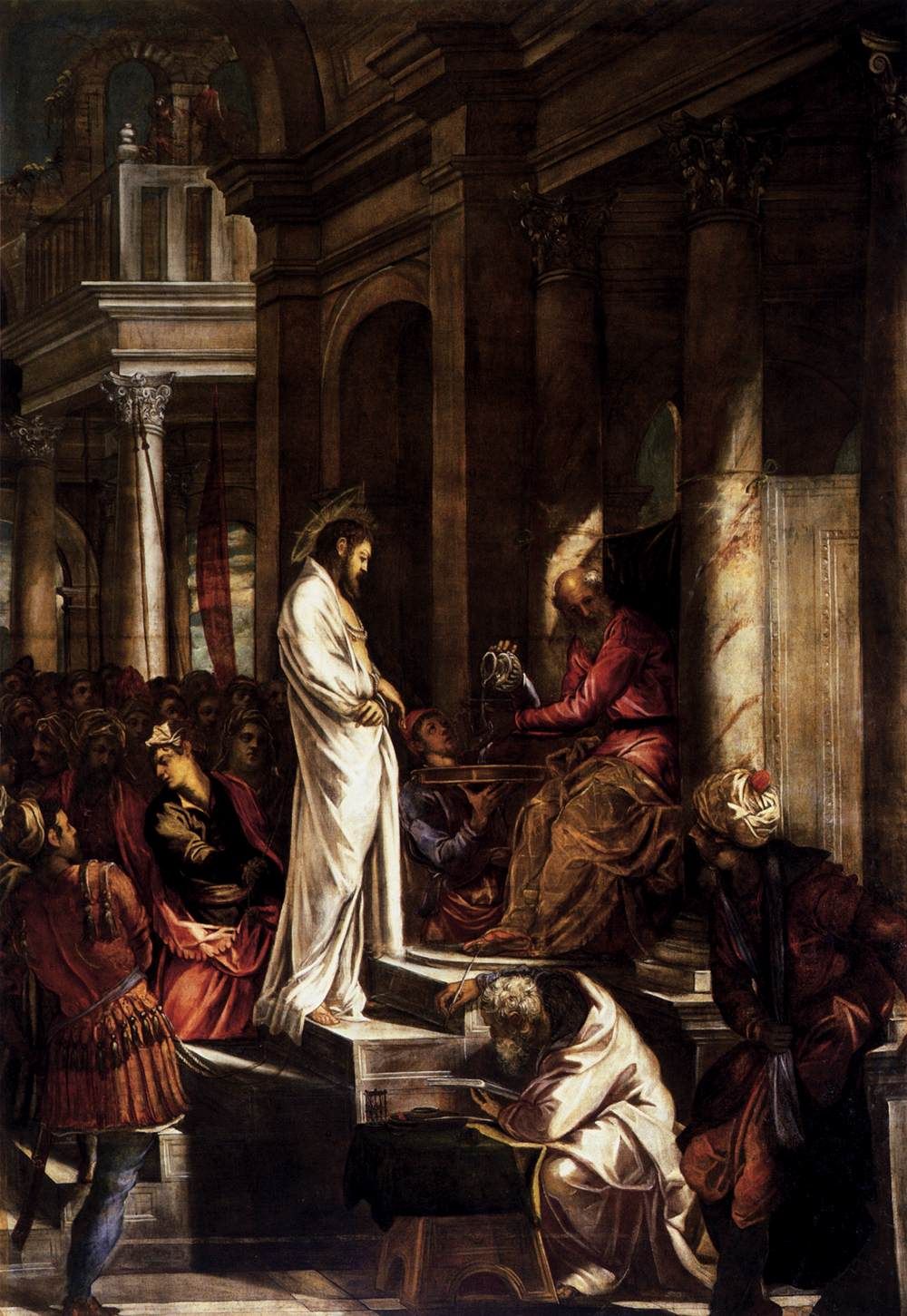 |
| Christ before Pilate, Tintoretto |
***
Peter agrees with the statements issued by the other followers of Jesus regarding the sentence of guilt in the first instance passed by the Sanhedrin.
This is painful news that, as we are well aware, has shocked many people, not only in Jerusalem. As already expressed on other occasions, we have the utmost respect for the judicial authority of the Jewish high priests.
Out of this respect, we await the outcome of the appeals process before Pontius Pilate, recalling that Jesus has maintained his innocence.
While awaiting the definitive judgement, we unite ourselves with all those feel victimized by his hard sayings, and reaffirm our commitment to do everything possible to provide a safe home for all, especially those who may feel unduly singled out by the challenge of Jesus' words and deeds.
In order to ensure the course of justice, Peter has confirmed the precautionary measures which all the followers of Jesus have already taken in fleeing the scene of his arrest in the Garden at Gethsemane. That is, while awaiting the definitive assessment of the facts by Pontius Pilate, as is the norm, Peter , like all the other followers of Jesus, is prepared to deny any connection to Jesus repeatedly, even as many as three times.
***
The above satire attempts to follow line-by-line the antiseptic, lawyerly statement from the Vatican following a conviction of Cardinal Pell earlier this week of the sexual abuse of minors. It was a conviction based on evidence so flimsy that even Pell's enemies can't figure it out. My post yesterday was a lament: the bishops are so utterly cowed by the magnitude of the sexual abuse crisis that they can't speak up for one of their own. Where are the prayers for Pell?
***
The Vatican's real statement on Pell:
Here is a Vatican-working translation of the statement on Cardinal George Pell, given today in the Holy See Press Office, by its Director “Ad Interim”, Alessandro Gisotti:
***
The Holy See agrees with the statement issued by the President of the Australian Catholic Bishops Conference regarding the sentence of guilt in the first instance concerning Cardinal George Pell.
This is painful news that, as we are well aware, has shocked many people, not only in Australia. As already expressed on other occasions, we have the utmost respect for the Australian judicial authorities.
Out of this respect, we await the outcome of the appeals process, recalling that Cardinal Pell maintains his innocence and has the right to defend himself until the last stage of appeal.
While awaiting the definitive judgement, we unite ourselves with the Australian bishops in praying for all victims of abuse, and reaffirm our commitment to do everything possible so that the Church might be a safe home for all, especially for children and the most vulnerable.
In order to ensure the course of justice, the Holy Father has confirmed the precautionary measures which had been imposed by the local Ordinary on Cardinal George Pell when he returned to Australia. That is, while awaiting the definitive assessment of the facts, as is the norm, Cardinal George Pell is prohibited from exercising public ministry and from having any voluntary contact whatsoever with minors.
Wednesday, February 27, 2019
Where are the prayers for Pell?
The Vatican Press Office's response yesterday to Cardinal George Pell's conviction -- which he is appealing -- was terse and very carefully worded, reading that the verdict "shocked many people, not only in Australia," and expressing unity with the Australian bishops in "praying for all victims of abuse."
The thought that I haven't been able to put out of my mind as I read and then reread the statement: Where are the prayers for Pell?
I know, I know. Even if Cardinal Pell has maintained his innocence, and even if both his friends and even his enemies are scratching their heads and trying to figure out how on earth he could have been convicted -- even then, the Vatican's response needed to be very, very carefully modulated. The Church can't be seen as taking the side of a priest or even an archbishop and a cardinal just because he is "one of their own." Such optics would be devastating to the argument that the Church is fully committed addressing the institutional cronyism that led to the shuffling around of abusive priests and the turning of a blind eye to the flagrant abuses of power of the likes of now-Mister McCarrick.
As much as I am eager to see the Church's swamp cleared and her wound cauterized, I am deeply fearful of the collateral damage being wreaked on the faithful clergy in the trenches. In my mind I'm thinking, what if he's innocent? To repeat, even Pell's enemies can't make sense of how the evidence has been twisted into anything plausible. So in my mind I'm imagining an elderly man who has given his entire life to the service of Christ being remanded today into police custody for the sort of heinous crime of child sexual abuse that, ironically, he was among the first in Australia to recognize as a major problem.
Pell's going to jail is bad enough, especially when Mr. McCarrick remains free and clear with no chance of doing jail time. My cri-de-coeur today, however, runs deeper. It seems to be that the anger of faithful Catholics at this despicable mess has run so deep that bishops and clergy are now too cowed to express any sort of solidarity with their own who stand among the accused. Again, I understand the rock-and-a-hard-place situation that generated the Vatican's terse statement. I understand the blow-back that any sort of expression of solidarity would have evoked. But the Vatican's statement reeks of lawyer-like risk management, not Christian compassion.
I met Cardinal Pell just one time when I was a seminarian studying in Rome. It was at one of the Lenten station churches, an early morning Mass. Maybe I served that Mass, or maybe I was just in the right place at the right moment as he headed into the sacristy, but I distinctly remember shaking his hand and wishing him a good morning. He's a towering figure, not only in his blunt rhetoric, but in his six-foot, three-inches stature. The point is, whether he's far away in Australia or not, Cardinal Pell is not an abstract idea to me. When I think of him being taken into custody, I'm thinking of a real person, and I'm thinking that I'd like him to know that I'm praying for him.
In sum, there's something unchristian about the way the Church has found it necessary, in this sex abuse crisis, to wash her hands of her own when they become a liability, at least publicly. Cardinal Pell is a particularly glaring case because the general consensus is that there is a miscarriage of justice occurring right now in Australia. Laypeople like myself and George Weigel, whose article is linked above, can say so openly. But not a brother bishop. Search around the news sites for any Australian bishops, many of them proteges of Pell, who, despite the improbability of the charges, have publicly stated that they're praying for their elderly confrere. I haven't found a single one.
I want the swamp cleared as much as any Catholic layman. But our leaders in the faith have been utterly cowed. I see bishops quickly washing their hands of their accused priests, their co-workers in the vineyard who have placed their hands in the hands of their bishop and promised obedience for life; I see bishops, who are successors of the apostles, washing their hands of their accused brethren, at least publicly. Browse around and read the antiseptic, lawyerly statements if you don't believe me. What have we brought about by means of our righteous anger?
The thought that I haven't been able to put out of my mind as I read and then reread the statement: Where are the prayers for Pell?
 |
| Image from WikiCommons |
I know, I know. Even if Cardinal Pell has maintained his innocence, and even if both his friends and even his enemies are scratching their heads and trying to figure out how on earth he could have been convicted -- even then, the Vatican's response needed to be very, very carefully modulated. The Church can't be seen as taking the side of a priest or even an archbishop and a cardinal just because he is "one of their own." Such optics would be devastating to the argument that the Church is fully committed addressing the institutional cronyism that led to the shuffling around of abusive priests and the turning of a blind eye to the flagrant abuses of power of the likes of now-Mister McCarrick.
As much as I am eager to see the Church's swamp cleared and her wound cauterized, I am deeply fearful of the collateral damage being wreaked on the faithful clergy in the trenches. In my mind I'm thinking, what if he's innocent? To repeat, even Pell's enemies can't make sense of how the evidence has been twisted into anything plausible. So in my mind I'm imagining an elderly man who has given his entire life to the service of Christ being remanded today into police custody for the sort of heinous crime of child sexual abuse that, ironically, he was among the first in Australia to recognize as a major problem.
Pell's going to jail is bad enough, especially when Mr. McCarrick remains free and clear with no chance of doing jail time. My cri-de-coeur today, however, runs deeper. It seems to be that the anger of faithful Catholics at this despicable mess has run so deep that bishops and clergy are now too cowed to express any sort of solidarity with their own who stand among the accused. Again, I understand the rock-and-a-hard-place situation that generated the Vatican's terse statement. I understand the blow-back that any sort of expression of solidarity would have evoked. But the Vatican's statement reeks of lawyer-like risk management, not Christian compassion.
I met Cardinal Pell just one time when I was a seminarian studying in Rome. It was at one of the Lenten station churches, an early morning Mass. Maybe I served that Mass, or maybe I was just in the right place at the right moment as he headed into the sacristy, but I distinctly remember shaking his hand and wishing him a good morning. He's a towering figure, not only in his blunt rhetoric, but in his six-foot, three-inches stature. The point is, whether he's far away in Australia or not, Cardinal Pell is not an abstract idea to me. When I think of him being taken into custody, I'm thinking of a real person, and I'm thinking that I'd like him to know that I'm praying for him.
In sum, there's something unchristian about the way the Church has found it necessary, in this sex abuse crisis, to wash her hands of her own when they become a liability, at least publicly. Cardinal Pell is a particularly glaring case because the general consensus is that there is a miscarriage of justice occurring right now in Australia. Laypeople like myself and George Weigel, whose article is linked above, can say so openly. But not a brother bishop. Search around the news sites for any Australian bishops, many of them proteges of Pell, who, despite the improbability of the charges, have publicly stated that they're praying for their elderly confrere. I haven't found a single one.
I want the swamp cleared as much as any Catholic layman. But our leaders in the faith have been utterly cowed. I see bishops quickly washing their hands of their accused priests, their co-workers in the vineyard who have placed their hands in the hands of their bishop and promised obedience for life; I see bishops, who are successors of the apostles, washing their hands of their accused brethren, at least publicly. Browse around and read the antiseptic, lawyerly statements if you don't believe me. What have we brought about by means of our righteous anger?
Tuesday, February 26, 2019
The danger of the double income
Yesterday I wrote about our culture's separation of work from the home environment ("The home is the woman's place, and the man's too"). A wife may feel, and rightly so, that there isn't a challenge fully worthy of her dignity in the dusting, the mopping, and the diapering. And a husband may come home after a hard day's work tired out and all too often failing in his obligations to the family other than financial provision. My argument, in short, is that the sharp division of work from the home has the potential to strain family unity by making it harder for both the husband and the wife fully to participate in all aspects of the "making" of the family.

None of this is intended to demean the hard work of men and women in situations where the financially remunerative work is wholly separate from the home environment. There are plenty of households, for example, that require extremely intensive management due to medical issues. There are homeschooling mothers who juggle the education of children on multiple grade levels all the while managing the day-to-day affairs of the home. On the other end, there are plenty of men who put in a full day's work at the office or the construction site only to come home, roll up their sleeves, and pitch in heroically in whatever way they're needed. For better or for worse, work these days most often occurs outside the home. It's simply the culture in which we live.
For all the heroism in the trenches, though, my unfashionable argument is still that shared, financially remunerative labor between husbands and wives is a strong familial "glue" that, though a radical exception in today's culture, has historically been the norm. Arguments to the contrary notwithstanding, the natural candidate for the most valuable contribution to the making of a family is financial provision. Without some sort of remunerative labor--that is, something that brings in the money to pay for the food, the mortgage or rent, the health insurance, the car payment, the utilities--there simply cannot be a family. In the strictest sense, every other contribution is secondary to the making of money. A maid could be hired to clean the house, the children could be sent to school. Only money is sine qua non; everything else is "extra," or a matter of choice or conviction. Note the cultural ennui in the late 40s through the late 50s with the introduction of washing machines and dryers, refrigerators, vacuums, and other time-saving gadgets. No need to wash the dishes when they could simply be put into the dishwasher; no need to grow a garden and preserve food for the winter when these things are readily available in the store. If these things are done, they're a matter of lifestyle choice, not of necessity.
So even if the woman is working heroically at home, and even if it's a matter of conviction that the family educate its own children, raise its own food, etc., etc., there may very naturally be an undercurrent of an idea that the wife's work is secondary to her husband's. This is the point I was trying to make yesterday in saying that women are not meant to be second-class citizens to their husbands. A woman needs work that is equal in dignity and just as necessary as her husband's. Again, I think this is what drives some women to seek employment outside the home. It's not a universal rule, and there are manifold reasons a woman may desire to work outside the home, but surely the underlying fact that the making of money is that without which a family cannot be a family is one of those reasons.
So the family becomes "dual income." At which time it likely becomes clear that all those seemingly secondary roles that the woman played in the home were very important after all. Everybody I know in a dual-income family readily admits that it's a struggle simply to be a family. Yes, a family needs to sit down to meals together. But who prepares those meals, and how do we manage to fit them into competing work schedules? Whose job brings in more income and takes priority when children need to be taken to appointments, school functions, etc.? The problem is not solved but rather intensified by the woman leaving the home. Again, I hasten to add that I am not demeaning those who are heroically living the "dual-income" reality, sometimes out of real necessity. I am simply pointing out the challenges that are likely to face a great many married couples who choose that difficult route.
To reiterate yesterday's point, I firmly believe that history gives us a real solution in shared, financially remunerative labor. I held up the idea of the small family farm--the route that my wife and I chose for ourselves. But obviously not everybody is called to be a farmer, and there are other challenging forms that the shared labor can take. I'm thinking, for example, of the husband and wife of a large homeschooling family I know that a number of years back opened a restaurant. From the sidelines I've watched as they've weathered the financial storms of starting a business from scratch. But they've also testified as to how they've had to weather those storms together, and how they've been brought closer as a family.
Does this mean that every husband who works outside the home needs to quit his job and start a farm or partner with his wife to open a restaurant? No, probably not. My purpose in writing these reflections is mainly to show how the separation of work from the home weakens one of the major bonds that, historically, has held families together. It's something to be aware of, for it's only when we've recognized an issue that we can identify whatever remedies may help, in our many and various family circumstances, to address that issue and strengthen our family situations as best we can.

None of this is intended to demean the hard work of men and women in situations where the financially remunerative work is wholly separate from the home environment. There are plenty of households, for example, that require extremely intensive management due to medical issues. There are homeschooling mothers who juggle the education of children on multiple grade levels all the while managing the day-to-day affairs of the home. On the other end, there are plenty of men who put in a full day's work at the office or the construction site only to come home, roll up their sleeves, and pitch in heroically in whatever way they're needed. For better or for worse, work these days most often occurs outside the home. It's simply the culture in which we live.
For all the heroism in the trenches, though, my unfashionable argument is still that shared, financially remunerative labor between husbands and wives is a strong familial "glue" that, though a radical exception in today's culture, has historically been the norm. Arguments to the contrary notwithstanding, the natural candidate for the most valuable contribution to the making of a family is financial provision. Without some sort of remunerative labor--that is, something that brings in the money to pay for the food, the mortgage or rent, the health insurance, the car payment, the utilities--there simply cannot be a family. In the strictest sense, every other contribution is secondary to the making of money. A maid could be hired to clean the house, the children could be sent to school. Only money is sine qua non; everything else is "extra," or a matter of choice or conviction. Note the cultural ennui in the late 40s through the late 50s with the introduction of washing machines and dryers, refrigerators, vacuums, and other time-saving gadgets. No need to wash the dishes when they could simply be put into the dishwasher; no need to grow a garden and preserve food for the winter when these things are readily available in the store. If these things are done, they're a matter of lifestyle choice, not of necessity.
So even if the woman is working heroically at home, and even if it's a matter of conviction that the family educate its own children, raise its own food, etc., etc., there may very naturally be an undercurrent of an idea that the wife's work is secondary to her husband's. This is the point I was trying to make yesterday in saying that women are not meant to be second-class citizens to their husbands. A woman needs work that is equal in dignity and just as necessary as her husband's. Again, I think this is what drives some women to seek employment outside the home. It's not a universal rule, and there are manifold reasons a woman may desire to work outside the home, but surely the underlying fact that the making of money is that without which a family cannot be a family is one of those reasons.
So the family becomes "dual income." At which time it likely becomes clear that all those seemingly secondary roles that the woman played in the home were very important after all. Everybody I know in a dual-income family readily admits that it's a struggle simply to be a family. Yes, a family needs to sit down to meals together. But who prepares those meals, and how do we manage to fit them into competing work schedules? Whose job brings in more income and takes priority when children need to be taken to appointments, school functions, etc.? The problem is not solved but rather intensified by the woman leaving the home. Again, I hasten to add that I am not demeaning those who are heroically living the "dual-income" reality, sometimes out of real necessity. I am simply pointing out the challenges that are likely to face a great many married couples who choose that difficult route.
To reiterate yesterday's point, I firmly believe that history gives us a real solution in shared, financially remunerative labor. I held up the idea of the small family farm--the route that my wife and I chose for ourselves. But obviously not everybody is called to be a farmer, and there are other challenging forms that the shared labor can take. I'm thinking, for example, of the husband and wife of a large homeschooling family I know that a number of years back opened a restaurant. From the sidelines I've watched as they've weathered the financial storms of starting a business from scratch. But they've also testified as to how they've had to weather those storms together, and how they've been brought closer as a family.
Does this mean that every husband who works outside the home needs to quit his job and start a farm or partner with his wife to open a restaurant? No, probably not. My purpose in writing these reflections is mainly to show how the separation of work from the home weakens one of the major bonds that, historically, has held families together. It's something to be aware of, for it's only when we've recognized an issue that we can identify whatever remedies may help, in our many and various family circumstances, to address that issue and strengthen our family situations as best we can.
Subscribe to:
Posts (Atom)